
..of course, the brain is not responsible for any of the sensations at all
– Aristotle
Topics
Serotonin
Many brain disorders, such as depression and anxiety, are at least partly caused by a dysfunction of the serotonergic system. But we must first understand what the function of serotonin is in the healthy brain before we can begin to shed light on what goes wrong in the brains of patients. I am interested in the role of serotonin in cognitive flexibility and how this neurotransmitter can aid us to either flexibly adjust our behavior to changes in the environment, or instead, put our heels in the sand and persist in our current behavioral patterns.
Psychedelics
Mind-expanding compounds such as psilocybin and LSD almost exclusively act through the serotonergic receptor 5HT2a. This receptor, and its counterpart 5HT2c, are implicated in cognitive flexibility with opposing effects. Therefore, I am very interested in how hallucinogenics exert their effects in the brain and the science behind psychedelic-assisted therapy, which was shown to be remarkably effective in the treatment of depression and addiction.
The Bayesian Brain
The brain does not encode anything in absolute terms. Instead, our brains build a model of the world based on prior experience and only springs into action when something happens that violates these preconceived expectations. You experience the strength of these expectations when, for example, you lift something that is much lighter than you thought. You overshoot your movement and it just feels wrong. I am interested in how the brain encodes and updates these prior beliefs on a neuronal level.
Multisensory integration
Our experience of the world around us is almost exclusively the result of a merging of multiple senses. Somehow the brain binds together information originating from different senses into a coherent experience. The question is: how do neurons ‘know’ which information originated from which sense?
Methods
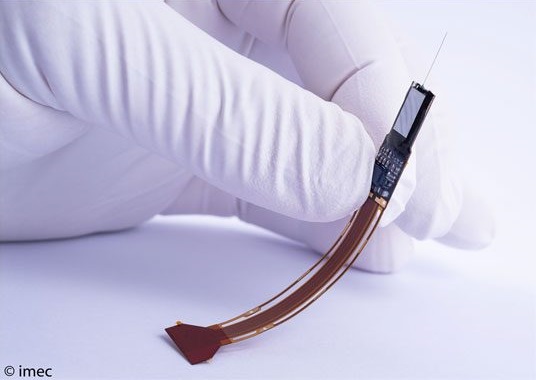
Electrophysiology
I use Neuropixel probes to record the activity of large populations of individual neurons across many different regions of the brain at the same time. These probes are as thick as a human hair and contain hundreds of contact points to record the electrical potential of neurons as they chatter away.
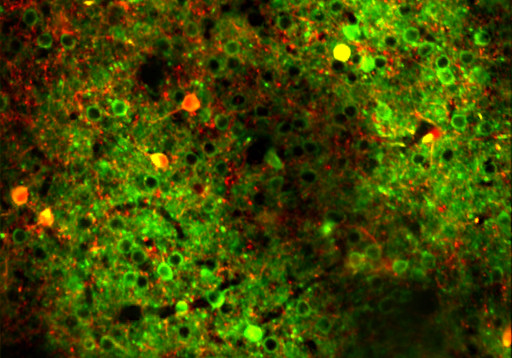
Calcium imaging
During my PhD I used two-photon calcium imaging to track the activity of groups of neurons over long timescales. By introducing a gene that expresses a fluorescent protein these neurons light up when they are illuminated using a focused laser beam. That way you can literally see their activity and follow them over the period of a month.
 Guido Meijer